
Hawai’i investment market: Resetting, not roaring
The Hawai’i investment market quietly reset in 2025 — and most people are still interpreting it wrong.

Yes, transaction volume surged to $2.96 billion, with deal counts up more than 40% year-over-year. On the surface, that looks like a hot market. But here’s the nuance:
Nearly 60% of that volume came from land transactions
Not traditional income-producing assets
And not necessarily reflective of broad market strength
What’s really happening
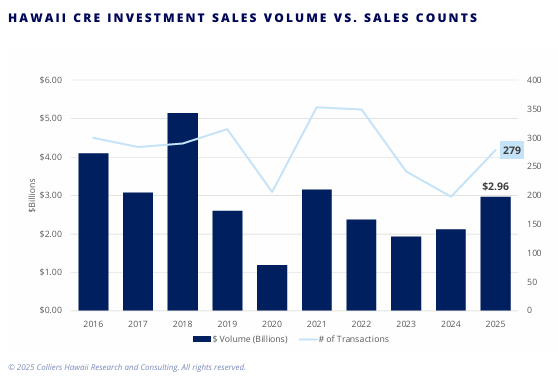
2025 was defined by megadeal land trades, including Daisho Co. Ltd.’s acquisition of the Royal Hawaiian Hotel land — one of the most significant transactions in Hawai’i’s history. These deals boosted headline numbers but don’t tell the full story of market fundamentals.
We’re seeing:
Capital re-engaging, but still highly selective
Buyers and sellers moving closer on pricing, though not fully aligned
More cautious underwriting tied to policy shifts and interest rate volatility
Investor sentiment improved steadily through the year, supported by stabilizing financing conditions and clearer economic signals. Liquidity is better than it was in 2024, but discipline remains the defining theme.
Heading into 2026
Conditions are stabilizing. Financing is loosening. Liquidity is improving. But this isn’t 2021 — it’s a transition market.
How I’m advising clients right now:
Buyers: Don’t chase headline volume. Focus on where pricing actually clears, especially in mid-market assets.
Sellers: The window is opening, but pricing must reflect today’s capital reality, not yesterday’s.
Sidelines: This is the kind of market where the best deals get done before confidence fully returns.
The bottom line
We’re not in a “hot” market. We’re in a re-engaging market — and that’s where strategy matters most. Hawai’i’s fundamentals remain strong, but success in 2026 will come from disciplined execution, not chasing momentum.
