
Oahu’s industrial market faces headwinds but holds firm
Oahu’s industrial real estate market closed 2025 with mixed signals, balancing resilience against mounting economic and policy challenges. While fundamentals remain strong, the sector is entering 2026 with caution as vacancy edges higher and tenant demand softens.
Market performance in Q4 2025

The quarter posted negative net absorption of 95,424 square feet, pushing the overall vacancy rate to 1.35%. This marks the sixth decline in the past eight quarters, underscoring weakening tenant demand. Despite this, limited inventory and land scarcity continue to anchor long-term stability. Asking rents reached a record $1.61 per square foot per month, up 5.23% year-over-year, while operating expenses climbed to $0.57 psf/mo, reflecting inflationary pressures across wages, utilities, and maintenance.
Economic and policy influences
Forecasts for 2026 remain uncertain. UHERO projects a mild recession, while DBEDT anticipates modest GDP growth of 1.5%. Tariff policy volatility is a major factor, reshaping cost structures in both construction and wholesale sectors. Steel and aluminum tariffs have driven material costs up sharply, forcing contractors to build in higher contingencies and slowing project feasibility. Wholesalers, meanwhile, face margin compression as costs rise 10–25%, prompting cautious inventory strategies and price resistance from customers.
Construction and development activity
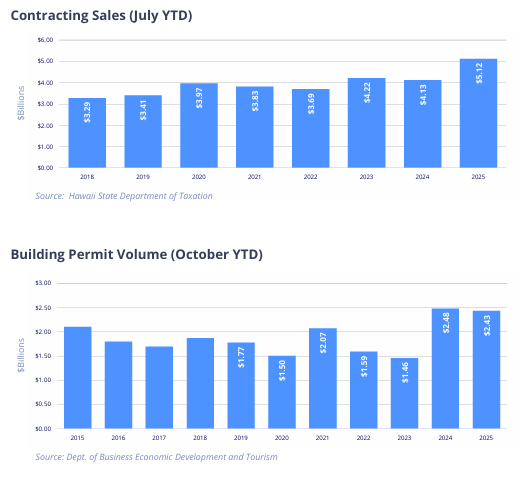
Despite headwinds, construction spending surged in 2025, with contracting sales reaching $5.12 billion year-to-date, fueled by large-scale projects like the Skyline rail system and Pearl Harbor Dry Dock 5. Building permits totaled $2.43 billion, signaling continued development momentum. New supply added 271,308 square feet in 2025, with another 307,000 square feet expected in 2026. While this will provide tenants limited options, vacancy is projected to remain within a historically low 1–2% range.
Looking ahead
Stakeholders should prepare for a more cautious leasing and investment climate in 2026. Rising rents, elevated operating costs, and tariff uncertainty will pressure both tenants and developers. Yet, Oahu’s industrial fundamentals — scarce land, strategic location, and strong demand for quality space — remain intact. Foreign Trade Zones (FTZs) may play a growing role in mitigating tariff impacts, offering tenants and landlords a competitive edge in an increasingly complex environment.
